A grounded RAG system that answers questions over your vendor and contract documents in seconds — cited to the source, or an honest “not found.” Here’s the everyday problem it solves, how it works, and who it fits.
This is the scenario we hear on almost every call with a document-heavy finance or AP team.
The everyday problem. Once a month, someone on the AP or finance team has to go through hundreds of vendor contracts and invoices by hand to answer a question like “do we have a signed NDA with this vendor?” or “what are the payment terms in this specific contract?” It takes hours, and if something gets missed, nobody finds out until it’s already a problem.
What we built. A system where you type the question in plain English — “which vendor contracts have net-30 payment terms?” — and it searches every document, gives you the answer with a link to the exact contract and clause, or tells you honestly it isn’t there. No guessing.
Fit for. Finance and AP teams at financial-services organizations (lending, insurance, factoring) with a lot of vendor and compliance paperwork — the kind of team currently doing this search by hand across shared drives and email, not on some abstract “digital transformation journey.”
Four real engineering decisions, in order — this is the actual architecture running on the live demo below.
Scanned and image-only PDFs are recognized with OCR (OpenAI vision, or a fully local engine for on-prem) and turned into searchable text alongside native files.
We embed the question alone (not diluted by a system prompt), pull a wide candidate set, then rerank by a hybrid of semantic score and literal keyword overlap — the clause that actually matches the question wins.
If the best retrieved match scores below a set relevance threshold, we refuse before the model ever runs — no low-confidence guess reaches the user.
The model answers only from the retrieved excerpts, with a strict system prompt: extract facts, quote the source, and say “not found” rather than invent.
A separate, isolated vector index per tenant — not a metadata filter — so cross-tenant leakage is structurally impossible, not just policy. Deployed on Vercel, Node runtime.
A design concept for a workspace built around this engine — sidebar, vendor documents, and an Ask screen with sources cited alongside every answer. Not a live product screen.
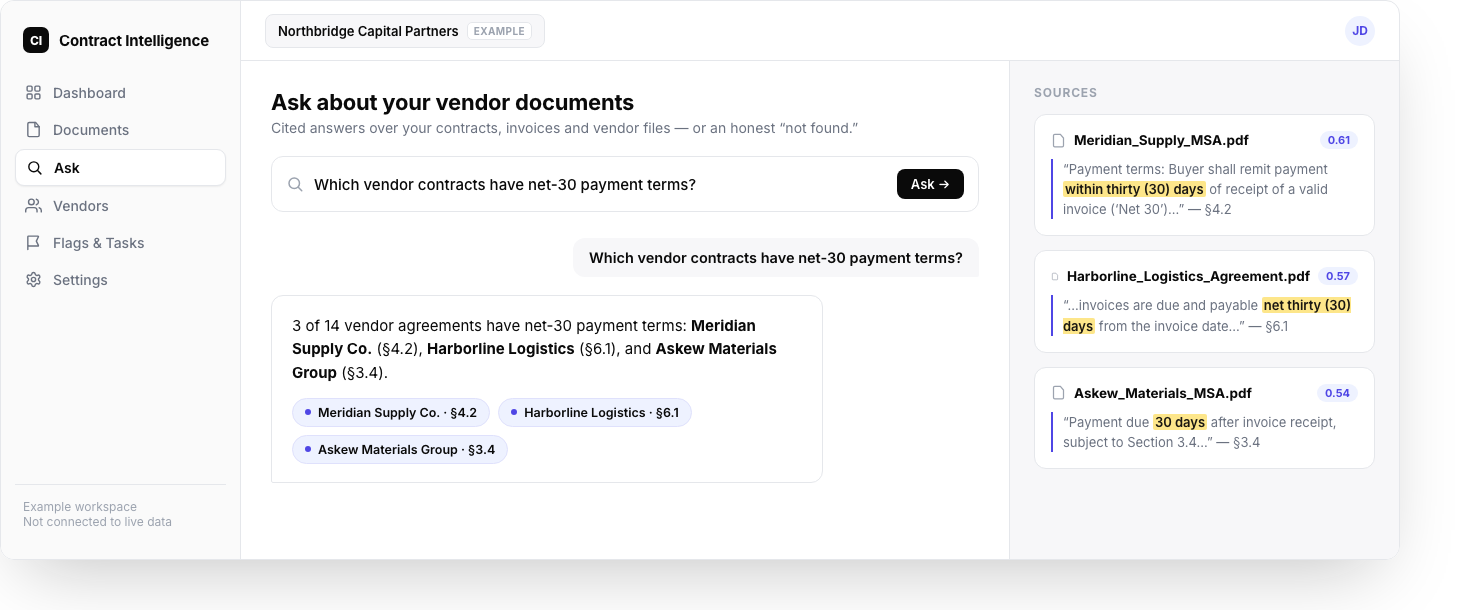
The answer names the exact vendors and clauses, with the matching excerpt from each source document alongside it.
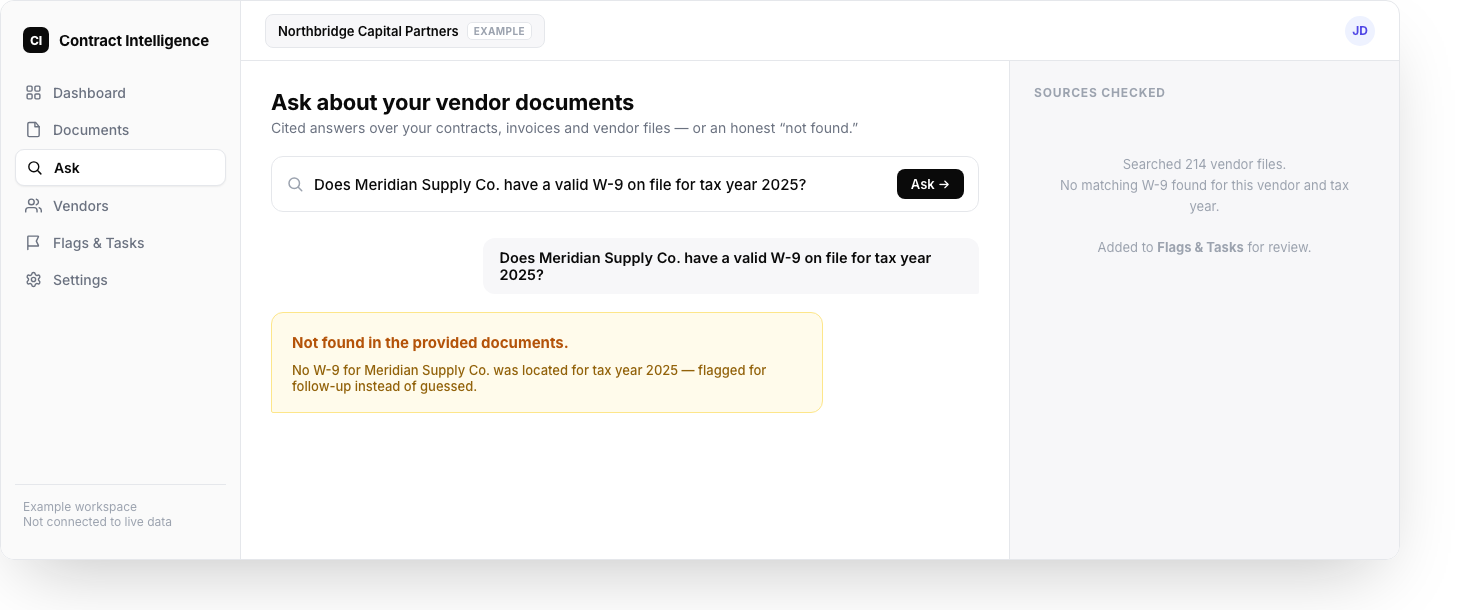
When nothing in the documents answers the question, it says so — and hands the gap to a review queue instead of guessing.
Here’s what you can check for yourself on the live demo below, instead of taking our word for it.
Source document and a similarity score ship with every answer — verify it yourself, don’t take our word for it.
Ask something the documents don’t contain — it says “not found,” not a plausible-sounding guess.
Image-only PDFs go through OCR and come out searchable and citable, same as native files.
Built into the architecture, not bolted on — a query against one client’s index cannot retrieve another’s.
This is a calculator, not a case study — plug in your own numbers. The default time-saved assumption is a starting point you should challenge, not a measured result.
Same retrieval, citation and refusal engine as the interface concept above — illustrated here with a vendor-contract question. Try your own on the live engine below.
3 of 14 vendor agreements have net-30 payment terms: Meridian Supply Co. (§4.2), Harborline Logistics (§6.1), and Askew Materials Group (§3.4). (Source: cited)
Not found in the provided documents.
Every answer is grounded in the retrieved excerpts and cited to its source, so it’s verifiable in seconds, not taken on faith. When the retrieved evidence is weak, it refuses instead of guessing — the confidence threshold for that is tunable per deployment.
The retrieval, citation and guardrail logic doesn’t change — only the documents it’s pointed at do. See the legal and AP pages for what that looks like for a specific team, typically a working pilot in 2–4 weeks.
Yes — that’s the point of it. The retrieval, citation and guardrail logic doesn’t change; only the documents it’s pointed at do.
Per-tenant isolation is structural (separate index per client, not a filter), and the same guardrail architecture supports on-prem/local OCR and a choice of LLM data-handling terms — see the security notes on the legal page for specifics.
Tell us what you’re searching for by hand today. We’ll show the live engine and scope a pilot on your own files.